ChatGPT, Claude and Gemini: Where AI Apps Rank on the App Store
Three AI assistants sat in the top 7 of the US Top Free chart on November 1, 2026, with ChatGPT also #1 in Top Grossing. We compare the ranks with November 14 and explain what a chart rank measures.
6 min read
Data as of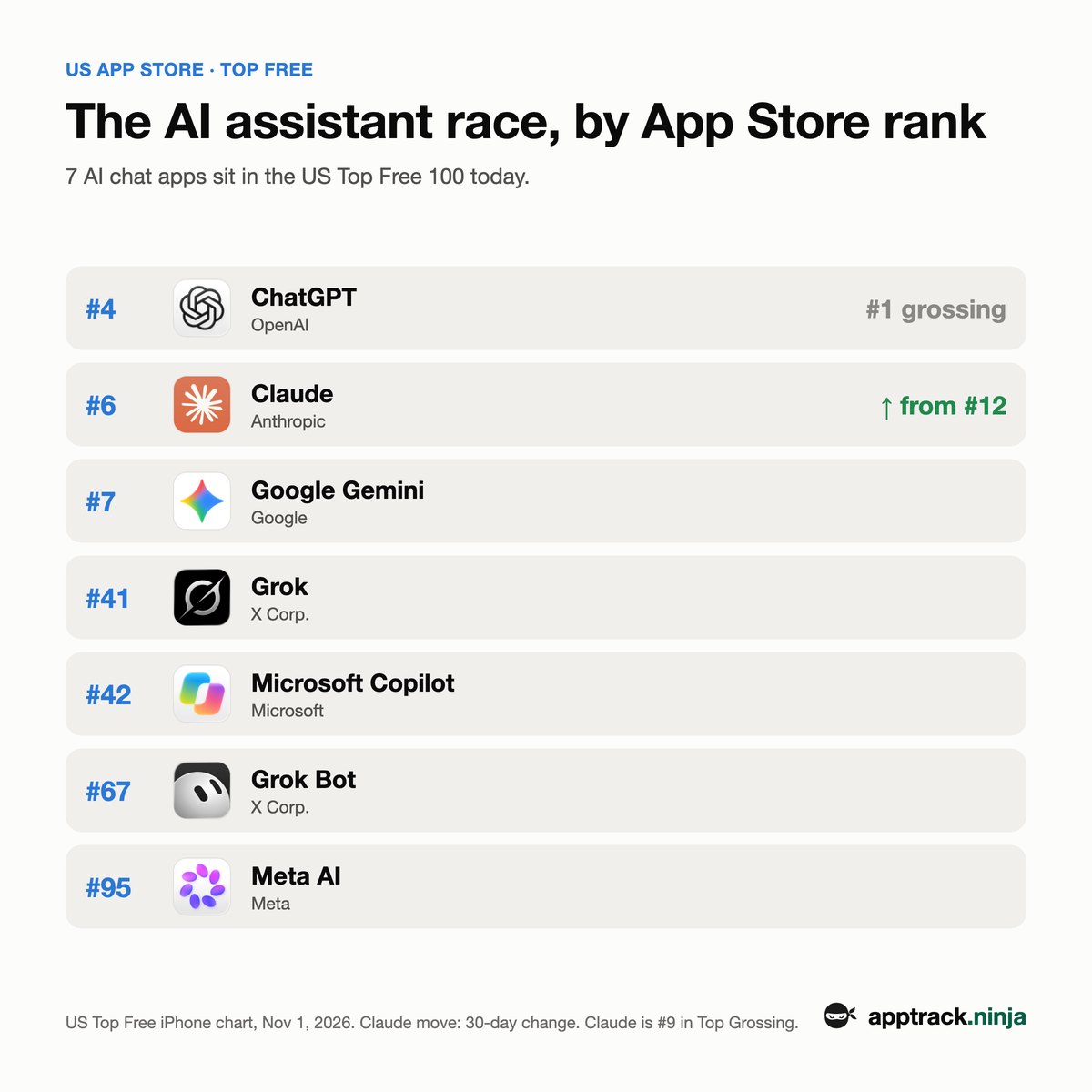
As of November 1, 2026, three AI assistants sat in the top 10 of the US App Store's Top Free chart: ChatGPT at #4, Claude at #6 and Gemini at #7. Grok was #41, Microsoft Copilot #42 and Meta AI #95. ChatGPT was also #1 in Top Grossing.
AppTrack Ninja reads these charts every day. This piece gives the ranks, compares them with November 14, and explains what a chart rank does and does not measure.
Where do ChatGPT, Claude and Gemini rank in the US App Store?
The ranks below come from the US Top Free iPhone chart on November 1, 2026. The publisher is the seller name shown on each app's App Store page.
- #4 ChatGPT, published by OpenAI OpCo, LLC
- #6 Claude, published by Anthropic PBC
- #7 Google Gemini, published by Google
- #41 Grok, published by X Corp.
- #42 Microsoft Copilot, published by Microsoft Corporation
- #95 Meta AI, published by Meta Platforms, Inc.
A seventh AI chat app was in the Top 100 that day: Grok Bot, a second app from X Corp., at #67. Claude had moved the most over the month before. Our daily history has it at #12 on October 2.
Where it stands now (November 14, 2026)
We read the same chart again on November 14, 2026. The top three kept their order and moved up or held. The other three slid, two of them out of the Top 100.
| App | Publisher | Top Free rank, Nov 1 | Top Free rank, Nov 14 |
|---|---|---|---|
| ChatGPT | OpenAI OpCo, LLC | #4 | #3 |
| Claude | Anthropic PBC | #6 | #5 |
| Google Gemini | #7 | #7 | |
| Grok | X Corp. | #41 | #58 |
| Microsoft Copilot | Microsoft Corporation | #42 | #142 |
| Meta AI | Meta Platforms, Inc. | #95 | #145 |
Grok Bot was #137 on November 14. In Top Grossing that day, ChatGPT was #1, Claude #10, Grok #27 and Gemini #158. All six apps are in the Productivity category, where the Top Free order was ChatGPT #2, Claude #3, Gemini #4, Grok #8, Copilot #14 and Meta AI #15.
What is the difference between Top Free and Top Grossing?
They answer different questions. Top Free orders free apps by how many times they are being downloaded. Top Grossing orders all apps by the money spent through the App Store, which includes in-app purchases and subscriptions.
Apple does not publish the exact formula of either chart, so treat both as orderings, not as measurements. A rank says an app is ahead of the one below it. It does not say by how much.
The two charts can disagree a lot for the same app. On November 14, Gemini was #7 in Top Free and #158 in Top Grossing, while Grok was #58 in Top Free and #27 in Top Grossing. Top Grossing only sees purchases made through the App Store, so neither rank describes a company's income.
Why is a chart rank a snapshot of downloads, not of usage?
A person who installed an assistant last year and opens it ten times a day adds nothing to today's Top Free rank. The chart counts new downloads. An app with a large installed base can be used heavily and still drift down the chart once most people who want it already have it.
The rank also moves from day to day. In our daily history for October 1 to November 14, ChatGPT stayed between #2 and #5, while Claude ranged from #19 to #5. Between November 1 and November 14, Microsoft Copilot was as high as #51 and as low as #162.
It can also depend on when the chart is read. The ranks in our November 1 post were read from the chart that day. The daily history we keep stores one reading per day, and for November 1 it holds ChatGPT #4, Claude #9, Gemini #12, Grok #45, Copilot #57 and Meta AI #91. Same day, same chart, a different reading.
So one screenshot of a chart is a weak basis for a conclusion. A rank held for several weeks says much more than a rank on one day.
How can you follow these ranks over time?
- Start from the chart. Trending apps shows Top Free, Top Paid and Top Grossing per storefront and is free to browse.
- Open the app page. Each app linked above shows its overall and category chart ranks. The full daily history is part of Pro.
- Compare windows, not days. Look at the best and worst rank over 30 days before you call something a rise or a fall.
- Check more than one country. A US rank says nothing about Japan or Turkey. Each storefront has its own chart.
- Ask from your own tools. The MCP server returns an app's chart ranks to an AI client, which is how the November 14 numbers here were read.
What this means for developers
Few indie apps will compete with these six for a chart position. The useful part is how to read charts and where the demand around them shows up.
- Benchmark in your category, not overall. Being #15 in a category chart can still mean #145 overall, as Meta AI shows. Pick the chart where your real rivals sit.
- Read Top Free and Top Grossing together. A rival high in downloads and absent from Top Grossing is in a different position from one that holds both.
- Look at search demand next to charts. Search popularity shows how popular a search term is on the App Store, so you can compare a generic term such as a kind of app with a brand name.
- See who advertises on those searches. Search Ads lists the apps running ads on an App Store search and their share of ads. The first keywords are open, the rest is Pro.
- Date every number you quote. Write the day and the chart next to a rank, as this article does. Two weeks moved three of these six apps by 17 to 100 places.