Do Icon and Screenshot Changes Move App Store Rankings? 34% Did
Of 333 measured icon and screenshot changes in the US App Store, 34% were followed by a better chart rank than usual. What that does and does not prove, and how to run your own test.
7 min read
Data as of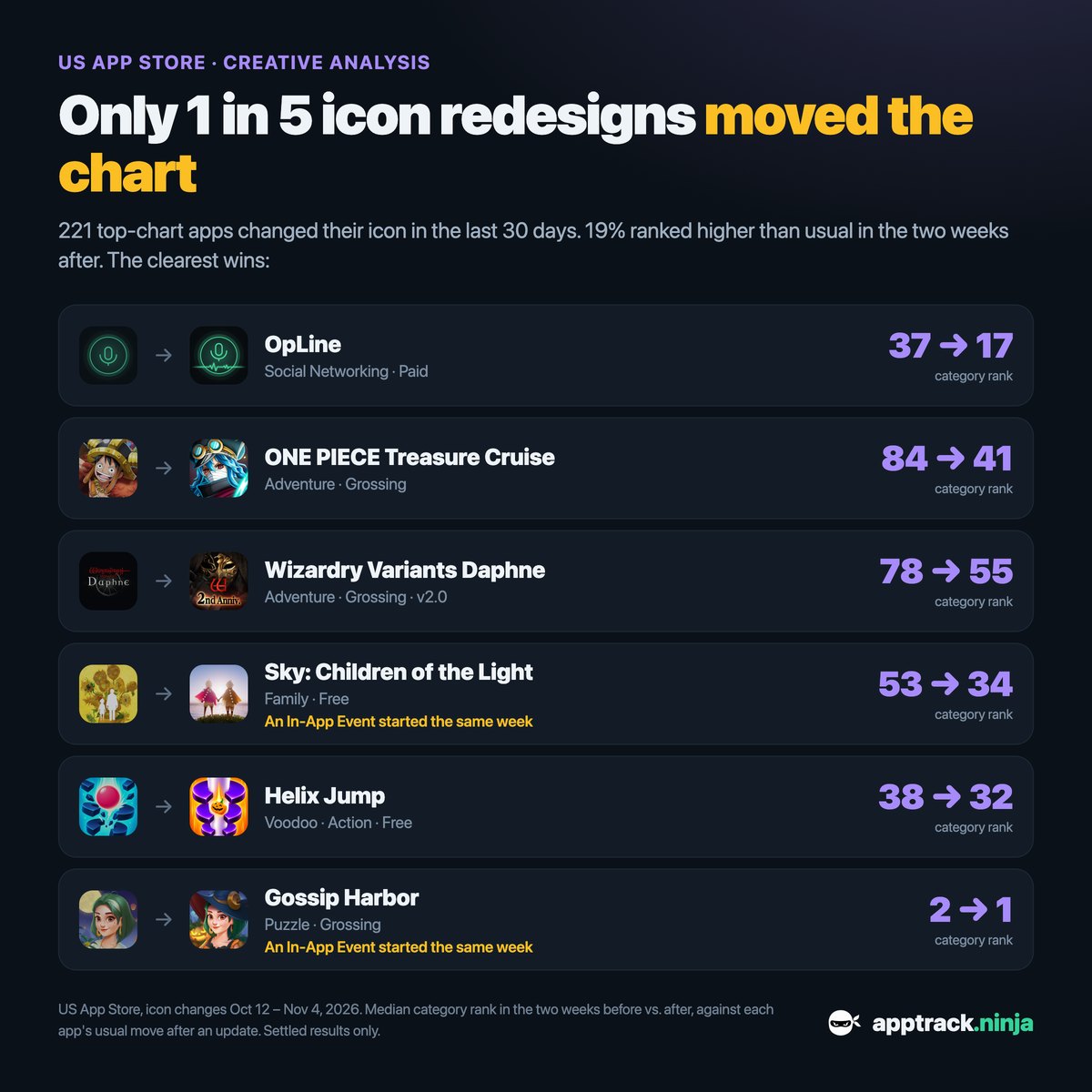
Sometimes, and less often than the best examples suggest. As of November 7, 2026, AppTrack Ninja had measured 333 icon and screenshot changes of charting apps in the US App Store since April, and 34% of them were followed by a better category rank than the app's updates usually bring.
The other two thirds were flat or worse. Below: the numbers, three examples, what they do and do not prove, and how to read a creative change of your own.
How do you measure whether a new icon moved the rank?
We compare the app's rank in its main category chart before and after the update that carried the new icon or screenshots. Before is the median rank over two weeks ahead of the update. After is the median over two weeks that start three days after it, once the new page has reached the store.
A raw before and after is not enough, because many apps move after any update. So each result is set against that app's usual move after updates that left the creatives alone. A change counts as a lift only when the rank improved clearly more than usual, and as a drop when it did clearly worse.
Only the icon and the first three screenshots are compared. A result settles 18 days after the update and does not change afterwards.
What did 333 icon and screenshot changes show?
Each app is counted once, by the change that moved its rank the most, so these figures lean toward the better outcomes.
| Measure | US App Store |
|---|---|
| Changes measured, one per app | 333 |
| Followed by a rank lift | 34% |
| Icon-only changes measured | 99 |
| Icon-only, rank lifted | 38 |
| Icon-only, rank dropped | 10 |
| Icon-only, no clear move | 51 |
Icon-only changes are the cleanest group, because the screenshots stayed the same. Of 99, 38 lifted and 10 dropped. That is almost four lifts for every drop, and yet in about half of the cases nothing measurable happened.
Three changes that were followed by a big move
| App | Change | Date | Category rank |
|---|---|---|---|
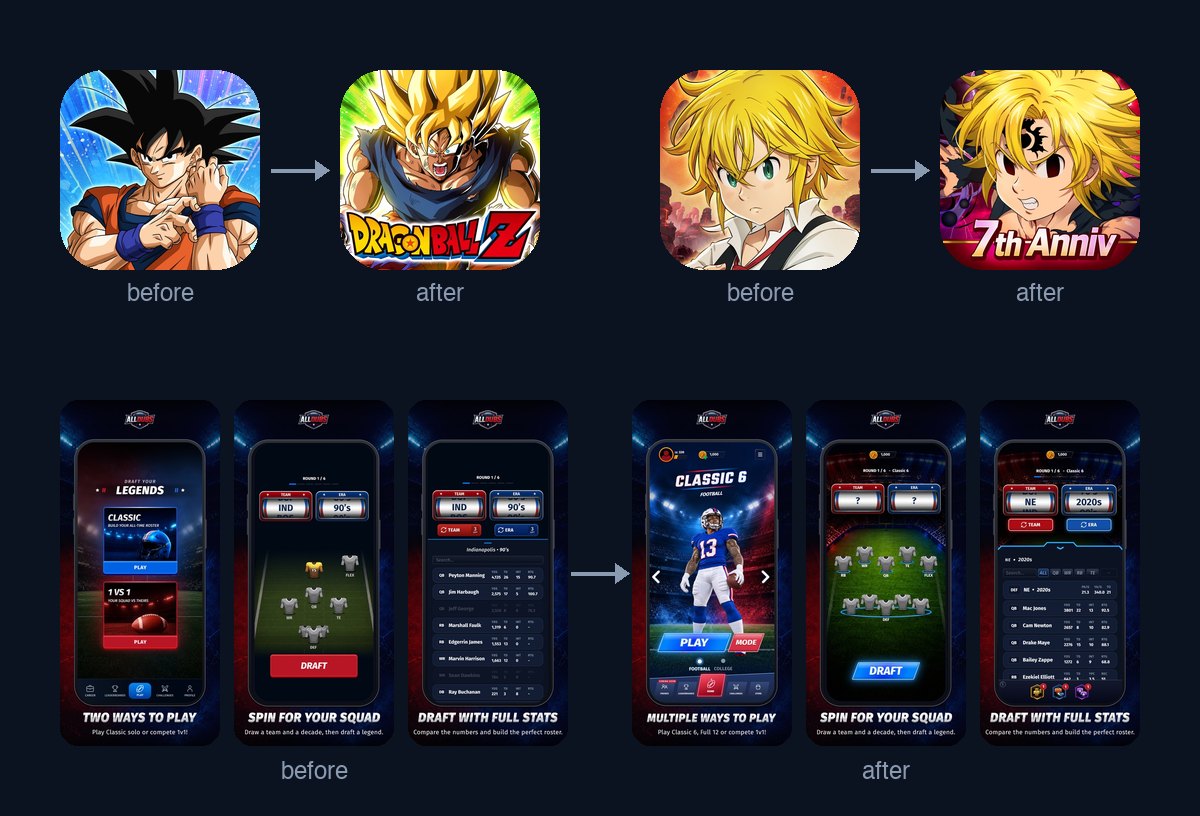
| DRAGON BALL Z DOKKAN BATTLE | Icon | Aug 29, 2026 | #37 to #6 |
| The Seven Deadly Sins | Icon | May 21, 2026 | #24 to #8 |
| All Dubs | Screenshots | Oct 7, 2026 | #40 to #1 |
DRAGON BALL Z DOKKAN BATTLE from Bandai Namco Entertainment changed its icon on August 29. The Seven Deadly Sins from Netmarble did the same on May 21. All Dubs, a sports game from Vaulty Studios, replaced its first three screenshots on October 7 and went to the top of its chart.
Does that mean the new icon caused the jump?
No. A rank change after a creative change is a correlation. The measurement removes one other explanation, the app's usual update effect, and nothing else.
The Seven Deadly Sins icon of May 21 carries a "7th Anniv" banner. An anniversary icon usually comes with an anniversary event in the game, and a grossing chart reacts to what players spend during it. The icon is more likely a sign of the event than the cause of the rank.
Dokkan Battle shows the other side. Its next icon change, on October 23, was followed by a fall from a median rank of 8 to 38.5 on the same chart, while its Dokkan Festival In-App Event, which began on October 14, ended on October 29. Same game, same kind of change, opposite result.
All Dubs went from about 4 new ratings a day before the change to about 41 after it. That fits a wave of new players, and the data cannot say how much of it the screenshots brought.
Other things that move a rank inside the same two weeks:
- The update itself: new content, features, fixes.
- Paid acquisition: a campaign that starts or stops.
- In-App Events and featuring by the store.
- Seasonality: a sports season or a holiday.
- Rivals: ranks are relative, so an app can rise because others fell.
We flag an ad campaign or In-App Event that starts or stops between the two windows, a rank that was already moving, and a second creative change close by. A flag lowers our confidence in a result. It does not correct it.
Where it stands now (November 14, 2026)
Since the first count the analysis has widened to as many as 200 charting apps per category, so the totals are larger. Read on November 14, 2026, for the US and the last 180 days: 2,866 apps had changed their icon or first screenshots, and 1,903 of them had a change with a measurable result.
| Change type | Apps measured | Lift, strongest change per app | Lift, latest change per app |
|---|---|---|---|
| Any | 1,903 | 28% | 19% |
| Icon only | 686 | 29% | 23% |
| Screenshots only | 1,349 | 23% | 17% |
Counting each app by its strongest change, as the November 7 figures did, 28% show a lift. Counting each app by its most recent change, which is closer to what to expect from your next redesign, the share is 19% and the median effect is zero.
Icons still do a little better than screenshots. But the four-to-one ratio of the first count did not hold in the larger set: 198 apps had an icon-only change followed by a lift, and 151 had one followed by a drop.
The card at the top of this article, from November 11, tells the same story for one month: of 221 charting apps with an icon change between October 12 and November 4, 19% ranked higher than usual afterwards.
How to test your own icon or screenshot change
- Change one thing. A new icon and new screenshots in one release cannot be told apart afterwards, and neither can a redesign shipped with a big content update.
- Note the release date and what else happened that week: campaigns, events, price changes, press.
- Wait for the window to close, then compare the two weeks before with the two weeks after. Use the median rank, not the best day.
- Compare against your own normal. If your rank usually improves a little after any update, only the part beyond that is news.
- Look at what rivals changed in the same weeks in Creative Analysis, and at their text and price changes in Store changes. A rival's drop can look like your lift.
- Repeat before you believe it. The Seven Deadly Sins has nine icon or screenshot changes on record between April 23 and October 29, and two of them, a week apart in May, were measured over windows that overlap by a week.
A chart rank is a blunt instrument for this question. Product page optimization in App Store Connect splits traffic between variants of the icon and screenshots, which measures conversion more directly. Chart data adds what a private test cannot show: what happened when other apps in your category made a similar change.
For ideas before a redesign, browse Icon inspiration. The list of creative changes is free to browse, and an app's full change history is part of Pro.